Exhibition Introduction
“What does it feel like to be human?” ——The Darwin Incident
In 1909, German zoologist Jakob Johann von Uexküll coined the term “Umwelt” (literally “environment”). This concept describes the distinct worlds that animals create within their bodily frameworks based on external signals interpreted through their sensory organs. Since each species has unique sensory capabilities and limitations, this leads to a bold conclusion: the variations of Umwelts are as numerous as the forms of living beings.
Consider humans as our first example: the human eye detects light waves ranging from 380 to 700 nanometers, yet it cannot perceive the infrared signals that rattlesnakes use to detect their prey, nor can it see the ultraviolet patterns that bees see on flowers. The human ear can pick up sounds within the frequency range of 20 to 20,000 Hz, but it cannot hear the high-frequency sounds produced by a bat during flight or the low-frequency signals that elephants make by stomping the ground. Needless to say, there are sensory experiences beyond our imagination, such as a shark’s electroreception or a sea turtle’s magnetic sense. So, how can we be so confident in assuming that the world we know encompasses the entirety of existence?
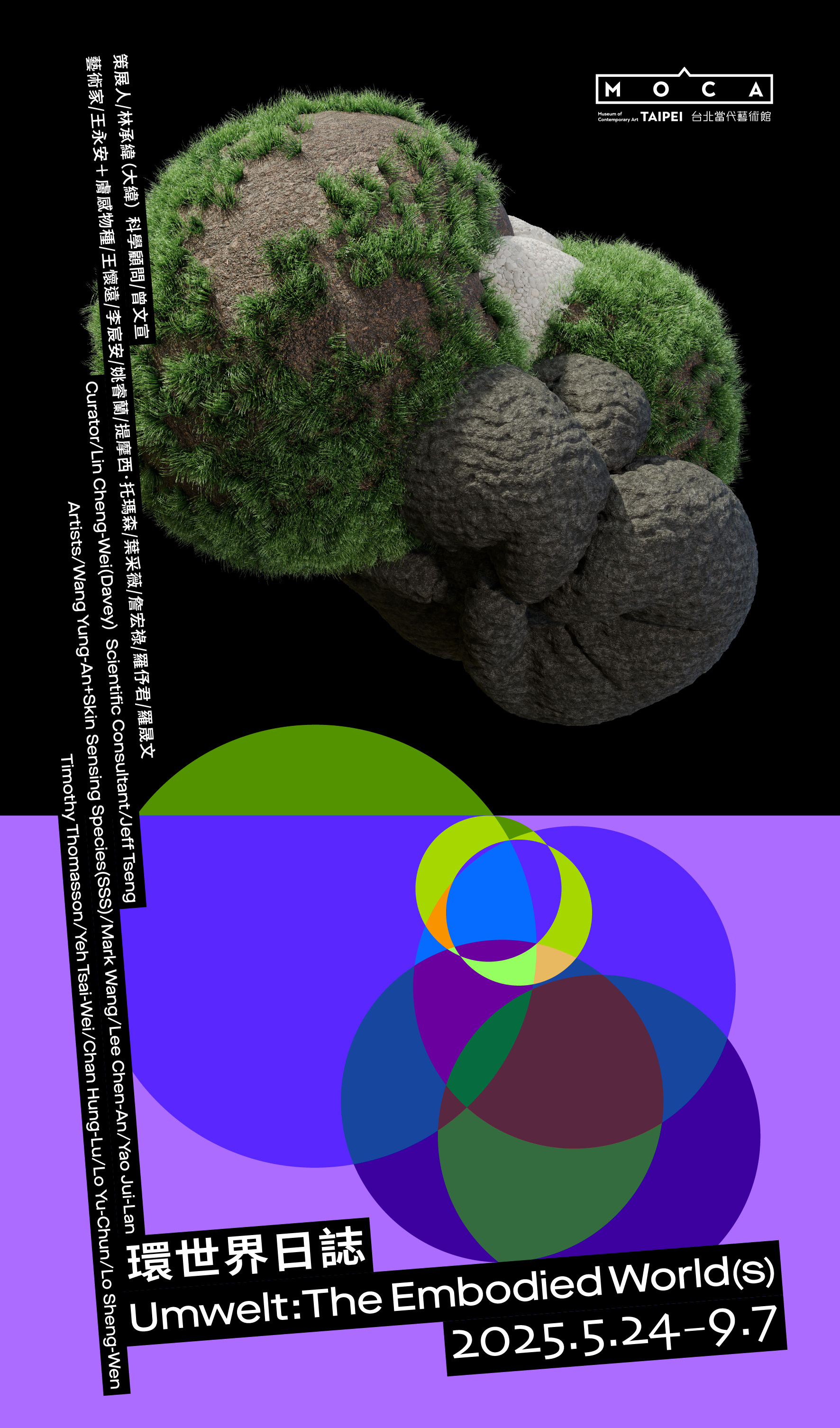
The exhibition Umwelt: The Embodied World(s) is one of the curatorial projects supported by the “2025 Emerging Art Program” launched by the Museum of Contemporary Art, Taipei. Curator Lin Cheng-Wei (Davey) has invited nine contemporary artists and art groups from Taiwan and abroad while collaborating with scientific partners, including the Institute of Molecular Biology at Academia Sinica, the National Center for Biomodels, and the exhibition’s science consultant, evolutionary biologist Dr. Jeff Tseng. By utilizing various artistic and scientific techniques and technologies, they closely observe and gain insights into the diverse Umwelts of organisms such as paramecia, cats, pigs, whales, and mice, creating distinct observation logs documenting their experiences.
In An Immense World, one of the most influential popular science works on sensory biology the author states: “Humans are the only species willing to deeply explore the senses of other animals, striving to come close to their perception.” This suggests that the key issue has never been whether humans can expand their sensory limits and replicate those of other animals through scientific research or technologies. The crucial question is whether we are ready to start this journey of “trying to get closer.”
By fully acknowledging the existence of numerous Umwelts and understanding that none of them represent the objective world in an absolute way, we can only start to genuinely explore the possibility of coexistences through differences.